Showing posts with label UK. Show all posts

Tuesday, August 24, 2010

Binge-Drinking is as British as Rain

Telegraph UK


Ken Jones, president of the Association of Chief Police Officers (ACPO), made headlines with his remarks to John Humphrys this week about the difficulties police face against "binge-drinking culture". Humphrys was looking for answers, but the ACPO chief provided none, only more questions: "Why is it we've got ourselves into the position where lager is sold cheaper than water? Why is it we've got huge entertainments and drinks companies marketing alcohol to children? Why is it we continue to see products developed that are solely targeted at young people?"

Why indeed? Or, on the other hand, why not? It's a free country (or free-ish), even for marketeers, lager manufacturers and off-licensees. If you make it, people will drink it, whether or not you double the price or legislate the purveyors within an inch of prohibition. This is a drinking nation. It's a national "culture", binge-drinking. Not the kind of culture that Andy Burnham wants taught five hours a week in the nation's state schools, ho ho, but a culture of sorts.

No rite of passage can be marked in these islands without bottles. Who can forget Alastair Campbell telling Tony Blair not to fret about Euan being found drunk? (Leicester Square, 2001, after his GCSEs.) "Every parent in the land will sympathise," said Alastair. He was right: Richard Littlejohn's smirking piece was headlined, "We've all been there, son", in the Sun.

Britain copes manfully with the clouds of gloom and dismay about violent drunkenness in the same way it copes with other miserable facts of nature, such as rain, HIPs, bad public transport, an NHS without doctors at night or 16-year-olds leaving school illiterate.

The slot about teenage binge-drinkers was not one of Humphrys's vintage Today inquisitions. He couldn't run an inquisition, mostly because not one spokesman from any of the various government departments with a brief on binge-drinking would come on the programme to be quizzed. Not Health, not Children 'n' Schools, not Home Office, not even young Andy from Culture, Media and Sport.

So all Humphrys could do was more or less bristle with why-oh-whys and something-must-be-dones. Under-age drunkenness is part of the national conversation. We have one every day, even down here in Bucolicshire. I'm forever giving the national response to my interlocutors' shocked remarks about yet another blameless father of four being kicked to death by drunken yobs: Oh, I know, tragic, awful - but what's to be done?

The answers come: "I blame the parents; I blame the Government's 24-hour drinking laws; I blame the telly ads that make drinking seem cool; I blame the publicans; I blame the supermarkets for selling lager cheaper than water (cheaper than milk, too, by the way); I blame the off-licences; I blame the iconification of George Best, Gazza." But what's to be done? Actually, I don't blame the publicans, but various ministers who have found themselves skewered on Humphrys's Fork at 8.10am have done.

Drunks in the street were always men; now women have equal opportunities, thanks to me and my sisters-in-arms on the feminist barricades. Drunks in the street used to be people who could pass for 18, or 16 at a pinch; now they're rolling out of primary schools. And drunks were always rude, rough people - what my mother called "dragged up in Rowmarsh Road", though I can't remember now where Rowmarsh Road was - but now they're nicely bred girls stumbling out of nicely appointed wine bars on hen nights.

As we were stringing up Christmas cards around the fireplace, I noticed an unfamiliar signatory who wrote her seasonal message thus: "Hope you have a really great Christmas and a fantastic TOTALLY BLADDERED New Year!!!!" Who on Earth? Oh, it's my friend, said the daughter, sniggering. Really? From school? The one with the MSc in rocket science? "Marine hydrography, and no it's not her. She doesn't drink a lot, actually."

It used not to be acceptable for young women to be seen sprawled and stumbling through the streets, held up by a yelling coven in disarray, busy filming everything on their mobiles. Now it's the genial duty of your daughter and mine at a hen night (I say "night"; it's more often a week) to encourage the bride-to-be into a state of falling-down inebriety.

"Everybody binges at hen nights. Except the ones who are pregnant. Pregnant girls don't drink. Not. At. All. But they sneak off to the bar to get their own drinks, like ­apple juice with a lot of water in it, so it looks like white wine - because people moan when you say you're not drinking, oh, this isn't going to be any fun, blah, blah."

There is, I reckon, nothing simple or Draconian to be done that can be imposed from above or enforced by government, judiciary and police to stop people drinking of their own accord. Maybe it's a millennial bug; maybe it's because there's a war on; maybe it's because drinking cheers people up. It's not just us, Rennes council has closed bars in the city to stop students binge-drinking. (How, pray? They'll go somewhere else.)

In the meantime, we'll continue to have national conversations about mayhem in the streets, while ministers and good, well-meaning people (not necessarily the same) try to think of things that will alter the national predilection for binge-drinking for ever.

Here's one. After much lobbying from (among others) the National Union of Teachers, the names of alcohol companies are now banned from children's replica football shirts.

So Everton can't sell shirts saying Chang Beer, Liverpool can't sell shirts saying Carlsberg and Hibernian can't sell shirts saying Whyte & Mackay. (Or perhaps they still can? Who knows? No one in England knows anything about what goes on in Scotland any more, what with them being a Nation Once Again and all.)

Brilliant, eh? That'll help a lot. In England, anyway. That's a start.

Hang on, though; the legislation that came into force on New Year's day only bans new sponsorship deals made after January 1, 2008. Not current ones. And Budweiser can still sponsor the Premier League and Carling the FA Cup. And for that matter Blackburn Rovers can merrily go on selling shirts saying Bet24 because that's not alcohol-related, but tut, tut, it's an online gambling site, isn't it? Don't they know it's addictive? Won't someone think of the children?

Wednesday, April 14, 2010

U.K. Reaches Limit on Binge Drinking

The Wall Street Journal

Great Britain's Drinking Problem Gets Political
CARDIFF, Wales—Around midnight on a recent Saturday night, 19-year-old Annelies Hopkins inventoried her evening's revelry: half a bottle of Jack Daniel's and four pints and six bottles of beer.

As she waited in line at Lloyds No. 1 Bar, Ms. Hopkins, a secretary by day, said she had no intention of slowing down. "No, speed up!" she cried. Ms. Hopkins and her sister, dressed in sleeveless tops despite the cold weather, convulsed in giggles.

Such raucous partying routinely turns the weekend streetscape here in the capital of Wales into a scene from "Night of the Living Dead." Drunken young men and women stumble through streets fouled with trash and broken glass, while the police labor to maintain order and tend to those needing help.

The U.K. is struggling with a rise in alcohol consumption that many people contend is fueling public disorder and violence. Alcohol abuse and "antisocial behavior" have become an issue in the run-up to the nation's general election, to be held May 6. Politicians have proposed remedies ranging from minimum alcohol prices to bans on barroom promotions to wider use of shatterproof cups in places where broken pint glasses are frequently used as weapons.


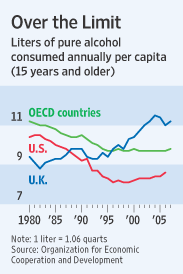
The U.K.'s problem is especially striking because of the contrast to what's been happening in many other industrialized nations. Per-capita consumption of alcohol in the U.K. rose 19% between 1980 and 2007, compared with a 13% decline for all 30 countries in the Organization for Economic Cooperation and Development, according to the most recent data. Average consumption over that period fell by about 17% in the U.S., 24% in Canada, 30% in Germany and 33% in France, according to the OECD.

David Jernigan, an alcohol expert at Johns Hopkins Bloomberg School of Public Health, says higher alcohol taxes and restrictions on marketing have contributed to the declines in many nations. But in the U.K., he says, longer hours for pubs, cheap supermarket booze and the advent of "alcopops"—premixed cocktails favored by young drinkers—have pushed numbers in the other direction.

In Cardiff, the toll on a recent Friday night suggested the scope of the problem. Police and paramedics responded to numerous reports of assault or injury, including drunken revelers tumbling down stairs and a young woman punching two police officers. The city's main drinking streets were littered with trash and empty bottles. Alleys and doorways reeked of urine.

An employee of one pub found a young woman lying on the sidewalk, vomiting and shivering in a red cocktail dress. Chris Williams, a volunteer "street pastor" who helps Cardiff cope with its night-life casualties, wrapped the woman in a foil blanket and helped her to a bench. Using the ill woman's cellphone, she called a number marked "Mum" and waited until her mother came.

The average Briton 15 and older drinks the equivalent of about 11.2 liters (about three gallons) of pure alcohol a year, compared with the OECD average of 9.7 liters, and 8.6 liters in the U.S. Over one-quarter of England's population is "drinking at hazardous levels," according to a recent report by the Royal College of Physicians and the National Health Service Confederation. The report said treating alcohol-related conditions cost the state-run health service about £2.7 billion (about $4 billion) in the fiscal year ended March 31, 2007, almost double the cost in 2001.

Alan Campbell, a minister in charge of crime reduction for the U.K.'s Home Office, says the ministry has taken various steps to combat alcohol-related problems, including cracking down on stores that sell booze to minors, hauling parents of underage drinkers into court, and financing advertisements that mock the sloppy behavior of binge drinkers.

Health experts say the availability of cheap alcohol is a major factor. U.K. supermarkets have long sold alcohol at a steep discount or even a loss to attract customers, and some market researchers say discounting appears to have intensified during the recession. Low prices, in turn, have prompted some pubs and clubs to cut drink prices and offer promotions including "all you can drink" specials.

Last year, Britain's chief medical adviser, Liam Donaldson, said the country should enforce a minimum price for alcohol, warning that "cheap alcohol is killing us as never before."

Some alcoholic-beverage companies and supermarkets oppose the idea. Paul Walsh, chief executive of liquor company Diageo PLC, says the government has "enough to focus on and should not be fiddling around with this." Adds Krishan Rama, spokesman for the British Retail Consortium: "We don't think minimum pricing is the answer. We think education and changing cultural attitudes would make a much bigger difference."

Some pubs say they're fed up with supermarkets' rock-bottom prices and would welcome minimum-price legislation.

"We find a lot of people will go and spend £10 on three bottles of wine before they come out on a Friday and Saturday night, so they're already well on their way to being absolutely plastered before they've even stepped in your door," says Cardiff pub manager Rebecca How. "I think most publicans and licensing bodies as well would probably support setting a minimum price for a unit of alcohol."

Heading into the election, U.K. political parties are moving to clamp down. The ruling Labour Party pushed legislation through Parliament that bans certain drink promotions, including a "dentist's chair" deal in which patrons recline and have alcohol poured into their mouths. Both the Labour and Conservative parties are promising to raise taxes on certain kinds of alcohol.

U.K. towns and regions also are taking action. Blackpool has mandated the use of plastic cups on weekend nights at pubs, to cut down on accidental cuts and "glassings," in which pint glasses are used as weapons. There are 87,000 "glass attacks" in the U.K. each year, according to the Home Office. Police in the city of Hull fine disorderly drinkers, photographing them and collecting their cellphone numbers.

Cardiff has mounted one of the most comprehensive responses, stepping up scrutiny of irresponsible pubs, parking ambulances on the busiest drinking streets and closing them off to traffic, and hiring extra city workers to maintain an orderly taxi line for drinkers trying to get home. Recently, city officials took the unusual step of refusing supermarket giants Tesco PLC and J Sainsbury PLC licenses to sell alcohol at new branches in the city center, telling them there already was too much alcohol sloshing around.

Judith Woodman, deputy leader of the Cardiff Council, says she doesn't think Cardiff's drinking problem is any worse than that of other British cities. "You can go to any big city and you will see binge-drinking problems and alcohol-related antisocial behavior," she says.

About five years ago, Cardiff city leaders decided they needed to do more to blunt the effects of binge drinking on the city center, where bars can attract between 40,000 and 140,000 people on a weekend night, depending on whether there's a sporting event at the stadium. Most weekends, Cardiff draws visitors from the small towns and former coal-mining valleys that lie to the north.

Police and city officials set up a "traffic-light" system for cracking down on pub violence. They tally assaults and other disturbances at each bar and assign points for each incident. If a pub or club accumulates a certain number of points over a six-month period, it enters a "red" zone, and police assign it a plan for improvement, including switching to plastic cups and adding extra closed-circuit television cameras and bouncers.

Pubs that don't comply or that fail to improve could lose their liquor licenses, says Trevor Jones, a police officer who helped create the program. Three clubs have been closed down so far, he says. Anticipating trouble with the police, one club switched to plastic, changed the color of its walls to soothing blues and greens, and started playing softer music toward the end of the evening—steps the police recommend to create a calmer atmosphere.

When Debbie Richards bought the Borough Arms pub seven years ago, it was known as a rough boozer that attracted football hooligans. She started refusing service to anyone who appeared to be a troublemaker. "If they were in a crowd of over eight to 10 men, or they come in chanting [football songs] because they've had a few—you just get a feeling," she says. She hires older bouncers less likely to lose their tempers. "They don't want to be injured in a fight," she says.

Police say better pub management has helped cut alcohol-related crime and disorder inside Cardiff's pubs and clubs, from 2,442 incidents in 2006 to 1,552 in 2008. They acknowledge that violence in the street isn't improving.

On the recent Friday evening, officers were called to one nightclub to detain a young man who had punched a woman in the face, according to police officer Tony Roach. At another bar, one man hit another with a bar stool, breaking two of his fingers.

Ms. Williams and her fellow Street Pastors, a Christian volunteer group, have been helping manage alcohol-related problems in Cardiff for 18 months or so. The volunteers, clad in blue parkas and baseball caps marked with the Street Pastor logo, walk the main drinking streets in pairs, looking for people to help.

That same Friday, Ms. Williams and her partner saw a young man being kicked out of a club because he was drunk and stumbling. They helped him walk to the nearest cash machine to withdraw money, then gave him water to try to sober him up before putting him in a cab.

Around 2:30 that morning, they came across a common after-hours sight: a woman walking barefoot because she was having trouble walking in her high heels. Ms. Williams handed the woman a free pair of flip-flops. "By that time of night you have urine and glass on the street," she says.

Some police officers say the problem has grown worse since 2005, when a change in the law allowed pubs to stay open past 11 p.m. Cheap drink deals have made it harder for police.

The pubs and clubs are aggressive in their pursuit of customers, paying people to hawk deals in the town center. On the recent Friday evening, a gaggle of women walked through town with "Free shots at Flares!" stickers on their clothing. Lava Lounge handed out fliers offering £1.50 beer, rum and gin before 11 p.m. Bars offer even cheaper deals midweek, often pitching them to students.

Lucy Slade, a 24-year-old hanging out with her friends, said she's often tempted by such deals. "You set out to get merry, but because it's so cheap, you get drunk," she said.

Around the corner, a young man wolfed down a hamburger while two of his friends urinated against a gate. "Binge drinking is the culture of today," he said before dropping his paper bag on the ground and running off with his friends.

Tuesday, January 19, 2010

UK Restricts Drinking Contests at Bars

The Canadian Press


LONDON — Officials will ban drinking contests in bars and force pub owners to offer patrons tap water in a bid to help tackle Britain's boozy culture, the government said Tuesday.

Doctors and health lobbyists said, however, that the government had failed to wield its most effective weapon - the imposition of minimum price controls on alcohol.

The raft of new measures is "better than nothing," according to Carys Davis, spokeswoman for the Alcohol Concern charity. She said "it does seem tame," although she acknowledged that the ban on drinking contests and other promotions could help control bingeing.

Alcohol consumption has emerged as a political issue in recent years in Britain. Weekends see many town centres awash with young people staggering from one bar to the next, and government statistics suggest the country's alcohol-related death rate has doubled since 1991.

Last year Chief Medical Officer Liam Donaldson suggested price controls could lead to nearly 100,000 fewer hospital admissions and 45,000 fewer crimes a year.

Home Secretary Alan Johnson told BBC radio Tuesday that he hadn't ruled out minimum pricing, but he didn't want to penalize "responsible drinkers on low incomes."

The new rules - expected to come into affect this year after being approved by Parliament - would ban speed-drinking competitions and all-you-can-drink offers. Bars would be required to offer drinks in smaller measures and tap water for free.

The rules are similar to a voluntary code drawn up by the Beer and Pub Association and adopted by much of Britain's alcohol industry in 2005. The code called for ending "irresponsible promotions," including all-you-can-drink offers, but a 2008 government-ordered report said the standards were being widely ignored.

"The industry has so far proved that it isn't able to regulate itself," Davis said.

The Beer and Pub Association said it supported measures by the government and alcoholics anonymous to deal with problem drinking, but said the government was unfairly targeting bars because most of Britain's booze was now being sold through supermarkets.

"Pubs are struggling, and the country is in recession. This is not the time for the Home Office to be burying business in yet more unnecessary red tape," association chief executive Brigid Simmonds said.

Monday, January 18, 2010

British Government Sets Minimum Alcohol Prices

All Headline News


London, England, United Kingdom (AHN) - To curb binge drinking among Britons, the British government will soon set minimum prices for alcoholic drinks. Health authorities have blamed cheap prices of beer, wine and spirit in supermarkets, pubs and similar night establishments for the rise in alcoholism among residents.

Under the new pricing guidelines, a six-pack of large would rise to $9.77 (6 pounds), a bottle of wine would increase to $7.33 (4.50 pounds), while cider would cost four times more current prices.

Hiking the prices of alcoholic drinks is the brainchild of Health Secretary Andy Burnham in a bid to reduce alcohol-related deaths and hospital admissions across the country and assist organizations like Alcoholics Anonymous. It is a turnaround from the previous Labor party stand to ease alcohol laws by permitting 24-hour drinking.

The rival Conservative party is considering putting precise and more specific contents on the labels of alcoholic drinks to replace the current units of measurement, which is misunderstood by many Britons.

Shadow Health Secretary Andrew Lansley said more clarity on food and drink labels would help Britons pursue a healthier lifestyle and battle obesity, teenage pregnancy, drug abuse and binge drinking.

Friday, January 8, 2010

From The UK: Condemnation Of Government Response To Alcoholism

Guardian UK


Government responses to Britain's "shocking" rise in binge drinking and alcoholism have ranged from "the non-existent to the ineffectual", the health select committee warns today.

Supermarkets and the drinks industry have more influence on government alcohol policies than health experts, the scornful report by MPs says.

Minimum prices, combined with restrictions on advertising and sponsorship, could save thousands of lives and billions of pounds a year.

The publication of the long-awaited report has triggered a fresh broadside of condemnation from health professionals frustrated by the failure of the government's strategy to tackle the escalating problems of drink-related violence and deaths.

The call for minimum pricing – already endorsed by England's chief medical officer, Sir Liam Donaldson, and backed by the Scottish government – does not receive the support of the three Conservative MPs on the health committee.

But the whole committee calls for a sharp rise in taxes on spirits and "industrial white cider", improved treatment services for alcoholics, a mandatory labelling scheme for drinks, and tougher regulation of alcohol promotion and advertising.

On minimum pricing, it says that a lower limit of 40p per unit of alcohol would cost a moderate drinker only 11p more a week and could save 1,100 lives a year. If the level were set at 50p a unit, it would save 3,000 people from liver disease and other fatal conditions.

Price controls would curb self-harm among young binge-drinkers and poorer, high-volume consumers, the report suggests, and they would encourage a switch-over to weaker wines and beers. Traditional pubs would also benefit, it says: the proposal is backed by the real ale campaign group Camra.

"The drinks industry is dependent on hazardous and harmful drinkers for three-quarters of its sales and, if people drank responsibly, alcohol sales would plummet by 40%," the report states.

English drinking habits have been transformed over the past 60 years, it warns. Average consumption has risen from an annual 3.5 litres of pure alcohol per head in 1947 to 9.5 now.

"The alcohol problem in this country reflects a failure of will and competence on the part of government department and quangos," says the report.

"We are concerned that government policies are much closer to, and too influenced by, those of the drinks industry and the supermarkets than those of expert health professionals."

When Sir Liam Donaldson backed minimum price controls last year, the prime minister rubbished his proposal, saying moderate drinkers should not suffer for the "excesses of a small minority". Last week, the NHS Confederation said alcohol abuse was costing the health service £2.7bn a year.

Dr Peter Carter, chief executive of the Royal College of Nursing, said: "Minimum pricing is essential and must be introduced alongside measures on labelling, sales and advertising, as part of an effective mandatory code."

Alison Rogers, chief executive of the British Liver Trust, commented: "Government vacillation and political cowardice are costing lives. Liver cirrhosis deaths have increased five-fold between 1970 and 2006, while in France, Italy and Spain, deaths have dropped between two- and four-fold." Professor Ian Gilmore, president of the Royal College of Physicians, added: "Politicians, first in Scotland but now more widely in the UK, are coming to the inevitable conclusion that existing policies to reduce health harms caused by alcohol misuse have failed … The time has come for stronger regulation, particularly on price and availability."

Dr Vivienne Nathanson, of the British Medical Association, said: "This cosy relationship [between the government, the drinks industry and supermarkets] needs to end and we need … minimum pricing, higher taxation, reduced availability, improved regulation and better treatment for patients who have alcohol addiction problems."

The Liberal Democrat health spokesperson, Sandra Gidley, a committee member, said: "Stopping alcohol being sold at pocket-money prices is vital to tackle the problems of Booze Britain and start the process of national alcohol rehab. Gordon Brown must listen to respected medical opinion."

The drinks industry rejected the proposal outright. A spokesperson for SABMiller said: "Minimum pricing will have an impact on the vast majority of responsible, law-abiding people who drink moderately, whilst it would be ineffective in addressing the minority of excessive drinkers."

The public health minister, Gillian Merron, conceded that "alcohol is an increasing challenge to people's health" and said that the government was stepping up its public awareness campaigns. "We will consider all of the committee's proposals carefully and respond to them formally in due course," she added.