The Wall Street Journal
Great Britain's Drinking Problem Gets Political
CARDIFF, Wales—Around midnight on a recent Saturday night, 19-year-old Annelies Hopkins inventoried her evening's revelry: half a bottle of Jack Daniel's and four pints and six bottles of beer.
As she waited in line at Lloyds No. 1 Bar, Ms. Hopkins, a secretary by day, said she had no intention of slowing down. "No, speed up!" she cried. Ms. Hopkins and her sister, dressed in sleeveless tops despite the cold weather, convulsed in giggles.
Such raucous partying routinely turns the weekend streetscape here in the capital of Wales into a scene from "Night of the Living Dead." Drunken young men and women stumble through streets fouled with trash and broken glass, while the police labor to maintain order and tend to those needing help.
The U.K. is struggling with a rise in alcohol consumption that many people contend is fueling public disorder and violence. Alcohol abuse and "antisocial behavior" have become an issue in the run-up to the nation's general election, to be held May 6. Politicians have proposed remedies ranging from minimum alcohol prices to bans on barroom promotions to wider use of shatterproof cups in places where broken pint glasses are frequently used as weapons.
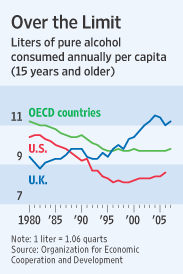
The U.K.'s problem is especially striking because of the contrast to what's been happening in many other industrialized nations. Per-capita consumption of alcohol in the U.K. rose 19% between 1980 and 2007, compared with a 13% decline for all 30 countries in the Organization for Economic Cooperation and Development, according to the most recent data. Average consumption over that period fell by about 17% in the U.S., 24% in Canada, 30% in Germany and 33% in France, according to the OECD.
David Jernigan, an alcohol expert at Johns Hopkins Bloomberg School of Public Health, says higher alcohol taxes and restrictions on marketing have contributed to the declines in many nations. But in the U.K., he says, longer hours for pubs, cheap supermarket booze and the advent of "alcopops"—premixed cocktails favored by young drinkers—have pushed numbers in the other direction.
In Cardiff, the toll on a recent Friday night suggested the scope of the problem. Police and paramedics responded to numerous reports of assault or injury, including drunken revelers tumbling down stairs and a young woman punching two police officers. The city's main drinking streets were littered with trash and empty bottles. Alleys and doorways reeked of urine.
An employee of one pub found a young woman lying on the sidewalk, vomiting and shivering in a red cocktail dress. Chris Williams, a volunteer "street pastor" who helps Cardiff cope with its night-life casualties, wrapped the woman in a foil blanket and helped her to a bench. Using the ill woman's cellphone, she called a number marked "Mum" and waited until her mother came.
 The average Briton 15 and older drinks the equivalent of about 11.2 liters (about three gallons) of pure alcohol a year, compared with the OECD average of 9.7 liters, and 8.6 liters in the U.S. Over one-quarter of England's population is "drinking at hazardous levels," according to a recent report by the Royal College of Physicians and the National Health Service Confederation. The report said treating alcohol-related conditions cost the state-run health service about £2.7 billion (about $4 billion) in the fiscal year ended March 31, 2007, almost double the cost in 2001.
Alan Campbell, a minister in charge of crime reduction for the U.K.'s Home Office, says the ministry has taken various steps to combat alcohol-related problems, including cracking down on stores that sell booze to minors, hauling parents of underage drinkers into court, and financing advertisements that mock the sloppy behavior of binge drinkers.
Health experts say the availability of cheap alcohol is a major factor. U.K. supermarkets have long sold alcohol at a steep discount or even a loss to attract customers, and some market researchers say discounting appears to have intensified during the recession. Low prices, in turn, have prompted some pubs and clubs to cut drink prices and offer promotions including "all you can drink" specials.
Last year, Britain's chief medical adviser, Liam Donaldson, said the country should enforce a minimum price for alcohol, warning that "cheap alcohol is killing us as never before."
Some alcoholic-beverage companies and supermarkets oppose the idea. Paul Walsh, chief executive of liquor company Diageo PLC, says the government has "enough to focus on and should not be fiddling around with this." Adds Krishan Rama, spokesman for the British Retail Consortium: "We don't think minimum pricing is the answer. We think education and changing cultural attitudes would make a much bigger difference."
Some pubs say they're fed up with supermarkets' rock-bottom prices and would welcome minimum-price legislation.
"We find a lot of people will go and spend £10 on three bottles of wine before they come out on a Friday and Saturday night, so they're already well on their way to being absolutely plastered before they've even stepped in your door," says Cardiff pub manager Rebecca How. "I think most publicans and licensing bodies as well would probably support setting a minimum price for a unit of alcohol."
Heading into the election, U.K. political parties are moving to clamp down. The ruling Labour Party pushed legislation through Parliament that bans certain drink promotions, including a "dentist's chair" deal in which patrons recline and have alcohol poured into their mouths. Both the Labour and Conservative parties are promising to raise taxes on certain kinds of alcohol.
U.K. towns and regions also are taking action. Blackpool has mandated the use of plastic cups on weekend nights at pubs, to cut down on accidental cuts and "glassings," in which pint glasses are used as weapons. There are 87,000 "glass attacks" in the U.K. each year, according to the Home Office. Police in the city of Hull fine disorderly drinkers, photographing them and collecting their cellphone numbers.
 Cardiff has mounted one of the most comprehensive responses, stepping up scrutiny of irresponsible pubs, parking ambulances on the busiest drinking streets and closing them off to traffic, and hiring extra city workers to maintain an orderly taxi line for drinkers trying to get home. Recently, city officials took the unusual step of refusing supermarket giants Tesco PLC and J Sainsbury PLC licenses to sell alcohol at new branches in the city center, telling them there already was too much alcohol sloshing around.
Judith Woodman, deputy leader of the Cardiff Council, says she doesn't think Cardiff's drinking problem is any worse than that of other British cities. "You can go to any big city and you will see binge-drinking problems and alcohol-related antisocial behavior," she says.
About five years ago, Cardiff city leaders decided they needed to do more to blunt the effects of binge drinking on the city center, where bars can attract between 40,000 and 140,000 people on a weekend night, depending on whether there's a sporting event at the stadium. Most weekends, Cardiff draws visitors from the small towns and former coal-mining valleys that lie to the north.
Police and city officials set up a "traffic-light" system for cracking down on pub violence. They tally assaults and other disturbances at each bar and assign points for each incident. If a pub or club accumulates a certain number of points over a six-month period, it enters a "red" zone, and police assign it a plan for improvement, including switching to plastic cups and adding extra closed-circuit television cameras and bouncers.
Pubs that don't comply or that fail to improve could lose their liquor licenses, says Trevor Jones, a police officer who helped create the program. Three clubs have been closed down so far, he says. Anticipating trouble with the police, one club switched to plastic, changed the color of its walls to soothing blues and greens, and started playing softer music toward the end of the evening—steps the police recommend to create a calmer atmosphere.
When Debbie Richards bought the Borough Arms pub seven years ago, it was known as a rough boozer that attracted football hooligans. She started refusing service to anyone who appeared to be a troublemaker. "If they were in a crowd of over eight to 10 men, or they come in chanting [football songs] because they've had a few—you just get a feeling," she says. She hires older bouncers less likely to lose their tempers. "They don't want to be injured in a fight," she says.
Police say better pub management has helped cut alcohol-related crime and disorder inside Cardiff's pubs and clubs, from 2,442 incidents in 2006 to 1,552 in 2008. They acknowledge that violence in the street isn't improving.
On the recent Friday evening, officers were called to one nightclub to detain a young man who had punched a woman in the face, according to police officer Tony Roach. At another bar, one man hit another with a bar stool, breaking two of his fingers.
Ms. Williams and her fellow Street Pastors, a Christian volunteer group, have been helping manage alcohol-related problems in Cardiff for 18 months or so. The volunteers, clad in blue parkas and baseball caps marked with the Street Pastor logo, walk the main drinking streets in pairs, looking for people to help.
That same Friday, Ms. Williams and her partner saw a young man being kicked out of a club because he was drunk and stumbling. They helped him walk to the nearest cash machine to withdraw money, then gave him water to try to sober him up before putting him in a cab.
Around 2:30 that morning, they came across a common after-hours sight: a woman walking barefoot because she was having trouble walking in her high heels. Ms. Williams handed the woman a free pair of flip-flops. "By that time of night you have urine and glass on the street," she says.
Some police officers say the problem has grown worse since 2005, when a change in the law allowed pubs to stay open past 11 p.m. Cheap drink deals have made it harder for police.
The pubs and clubs are aggressive in their pursuit of customers, paying people to hawk deals in the town center. On the recent Friday evening, a gaggle of women walked through town with "Free shots at Flares!" stickers on their clothing. Lava Lounge handed out fliers offering £1.50 beer, rum and gin before 11 p.m. Bars offer even cheaper deals midweek, often pitching them to students.
Lucy Slade, a 24-year-old hanging out with her friends, said she's often tempted by such deals. "You set out to get merry, but because it's so cheap, you get drunk," she said.
Around the corner, a young man wolfed down a hamburger while two of his friends urinated against a gate. "Binge drinking is the culture of today," he said before dropping his paper bag on the ground and running off with his friends.
As she waited in line at Lloyds No. 1 Bar, Ms. Hopkins, a secretary by day, said she had no intention of slowing down. "No, speed up!" she cried. Ms. Hopkins and her sister, dressed in sleeveless tops despite the cold weather, convulsed in giggles.
Such raucous partying routinely turns the weekend streetscape here in the capital of Wales into a scene from "Night of the Living Dead." Drunken young men and women stumble through streets fouled with trash and broken glass, while the police labor to maintain order and tend to those needing help.
The U.K. is struggling with a rise in alcohol consumption that many people contend is fueling public disorder and violence. Alcohol abuse and "antisocial behavior" have become an issue in the run-up to the nation's general election, to be held May 6. Politicians have proposed remedies ranging from minimum alcohol prices to bans on barroom promotions to wider use of shatterproof cups in places where broken pint glasses are frequently used as weapons.
The U.K.'s problem is especially striking because of the contrast to what's been happening in many other industrialized nations. Per-capita consumption of alcohol in the U.K. rose 19% between 1980 and 2007, compared with a 13% decline for all 30 countries in the Organization for Economic Cooperation and Development, according to the most recent data. Average consumption over that period fell by about 17% in the U.S., 24% in Canada, 30% in Germany and 33% in France, according to the OECD.
David Jernigan, an alcohol expert at Johns Hopkins Bloomberg School of Public Health, says higher alcohol taxes and restrictions on marketing have contributed to the declines in many nations. But in the U.K., he says, longer hours for pubs, cheap supermarket booze and the advent of "alcopops"—premixed cocktails favored by young drinkers—have pushed numbers in the other direction.
In Cardiff, the toll on a recent Friday night suggested the scope of the problem. Police and paramedics responded to numerous reports of assault or injury, including drunken revelers tumbling down stairs and a young woman punching two police officers. The city's main drinking streets were littered with trash and empty bottles. Alleys and doorways reeked of urine.
An employee of one pub found a young woman lying on the sidewalk, vomiting and shivering in a red cocktail dress. Chris Williams, a volunteer "street pastor" who helps Cardiff cope with its night-life casualties, wrapped the woman in a foil blanket and helped her to a bench. Using the ill woman's cellphone, she called a number marked "Mum" and waited until her mother came.
Alan Campbell, a minister in charge of crime reduction for the U.K.'s Home Office, says the ministry has taken various steps to combat alcohol-related problems, including cracking down on stores that sell booze to minors, hauling parents of underage drinkers into court, and financing advertisements that mock the sloppy behavior of binge drinkers.
Health experts say the availability of cheap alcohol is a major factor. U.K. supermarkets have long sold alcohol at a steep discount or even a loss to attract customers, and some market researchers say discounting appears to have intensified during the recession. Low prices, in turn, have prompted some pubs and clubs to cut drink prices and offer promotions including "all you can drink" specials.
Last year, Britain's chief medical adviser, Liam Donaldson, said the country should enforce a minimum price for alcohol, warning that "cheap alcohol is killing us as never before."
Some alcoholic-beverage companies and supermarkets oppose the idea. Paul Walsh, chief executive of liquor company Diageo PLC, says the government has "enough to focus on and should not be fiddling around with this." Adds Krishan Rama, spokesman for the British Retail Consortium: "We don't think minimum pricing is the answer. We think education and changing cultural attitudes would make a much bigger difference."
Some pubs say they're fed up with supermarkets' rock-bottom prices and would welcome minimum-price legislation.
"We find a lot of people will go and spend £10 on three bottles of wine before they come out on a Friday and Saturday night, so they're already well on their way to being absolutely plastered before they've even stepped in your door," says Cardiff pub manager Rebecca How. "I think most publicans and licensing bodies as well would probably support setting a minimum price for a unit of alcohol."
Heading into the election, U.K. political parties are moving to clamp down. The ruling Labour Party pushed legislation through Parliament that bans certain drink promotions, including a "dentist's chair" deal in which patrons recline and have alcohol poured into their mouths. Both the Labour and Conservative parties are promising to raise taxes on certain kinds of alcohol.
U.K. towns and regions also are taking action. Blackpool has mandated the use of plastic cups on weekend nights at pubs, to cut down on accidental cuts and "glassings," in which pint glasses are used as weapons. There are 87,000 "glass attacks" in the U.K. each year, according to the Home Office. Police in the city of Hull fine disorderly drinkers, photographing them and collecting their cellphone numbers.

Judith Woodman, deputy leader of the Cardiff Council, says she doesn't think Cardiff's drinking problem is any worse than that of other British cities. "You can go to any big city and you will see binge-drinking problems and alcohol-related antisocial behavior," she says.
About five years ago, Cardiff city leaders decided they needed to do more to blunt the effects of binge drinking on the city center, where bars can attract between 40,000 and 140,000 people on a weekend night, depending on whether there's a sporting event at the stadium. Most weekends, Cardiff draws visitors from the small towns and former coal-mining valleys that lie to the north.
Police and city officials set up a "traffic-light" system for cracking down on pub violence. They tally assaults and other disturbances at each bar and assign points for each incident. If a pub or club accumulates a certain number of points over a six-month period, it enters a "red" zone, and police assign it a plan for improvement, including switching to plastic cups and adding extra closed-circuit television cameras and bouncers.
Pubs that don't comply or that fail to improve could lose their liquor licenses, says Trevor Jones, a police officer who helped create the program. Three clubs have been closed down so far, he says. Anticipating trouble with the police, one club switched to plastic, changed the color of its walls to soothing blues and greens, and started playing softer music toward the end of the evening—steps the police recommend to create a calmer atmosphere.
When Debbie Richards bought the Borough Arms pub seven years ago, it was known as a rough boozer that attracted football hooligans. She started refusing service to anyone who appeared to be a troublemaker. "If they were in a crowd of over eight to 10 men, or they come in chanting [football songs] because they've had a few—you just get a feeling," she says. She hires older bouncers less likely to lose their tempers. "They don't want to be injured in a fight," she says.
Police say better pub management has helped cut alcohol-related crime and disorder inside Cardiff's pubs and clubs, from 2,442 incidents in 2006 to 1,552 in 2008. They acknowledge that violence in the street isn't improving.
On the recent Friday evening, officers were called to one nightclub to detain a young man who had punched a woman in the face, according to police officer Tony Roach. At another bar, one man hit another with a bar stool, breaking two of his fingers.
Ms. Williams and her fellow Street Pastors, a Christian volunteer group, have been helping manage alcohol-related problems in Cardiff for 18 months or so. The volunteers, clad in blue parkas and baseball caps marked with the Street Pastor logo, walk the main drinking streets in pairs, looking for people to help.
That same Friday, Ms. Williams and her partner saw a young man being kicked out of a club because he was drunk and stumbling. They helped him walk to the nearest cash machine to withdraw money, then gave him water to try to sober him up before putting him in a cab.
Around 2:30 that morning, they came across a common after-hours sight: a woman walking barefoot because she was having trouble walking in her high heels. Ms. Williams handed the woman a free pair of flip-flops. "By that time of night you have urine and glass on the street," she says.
Some police officers say the problem has grown worse since 2005, when a change in the law allowed pubs to stay open past 11 p.m. Cheap drink deals have made it harder for police.
The pubs and clubs are aggressive in their pursuit of customers, paying people to hawk deals in the town center. On the recent Friday evening, a gaggle of women walked through town with "Free shots at Flares!" stickers on their clothing. Lava Lounge handed out fliers offering £1.50 beer, rum and gin before 11 p.m. Bars offer even cheaper deals midweek, often pitching them to students.
Lucy Slade, a 24-year-old hanging out with her friends, said she's often tempted by such deals. "You set out to get merry, but because it's so cheap, you get drunk," she said.
Around the corner, a young man wolfed down a hamburger while two of his friends urinated against a gate. "Binge drinking is the culture of today," he said before dropping his paper bag on the ground and running off with his friends.


